3 Tips on Ensuring Fire Safety at Home

Tips on ensuring fire safety at home

More often than not, fire hazards are overlooked when talking about hazards. This could be because we may assume that it takes a major mishap to trigger one. However, the reality is that fires can start anywhere, even in our own homes. Hence, ensuring fire safety in your home might be one of the only ways to help you and your loved ones respond well if the situation arises. As such, here are a few handy tips to keep in mind about maintaining fire safety at home.

Stay Alert when Cooking 

It is extremely important to be alert at all times when you’re in the kitchen. Minimising distractions reduces the chances of a huge fire breaking out as you would be quicker in responding to it. Ensure that you turn off radios or televisions if you know you’re easily distracted. Also, keep any items that could easily catch fire, such as paper towels, cloths, or wooden objects a distance away from the stovetop. Taking these precautionary steps will be extremely beneficial in fire prevention at home

Unplug Electrical Appliances

Another tip would be to unplug electrical appliances that aren’t in use from the sockets. This prevents them from overheating and emitting sparks that could easily turn into a huge fire. If there are toddlers in your home, you could do one of two things; leave fire starters out of their reach, or put up safety locks on drawers that contain these fire starters. This will ensure that they wouldn’t stumble upon those items even by accident. If your children are much older, a talk on fire prevention might come in handy too! Apart from that, you could also try to avoid overloading power sockets. This will prevent the plugs from overheating and causing a fire. 

Create a Fire Escape Plan

Finally, discuss with your family and come up with a fire escape plan. Having a well-thought-out plan will ensure efficiency in getting everyone to safety, which may help reduce the chances of anyone blanking out the minute they see a fire. There are a few elements you could add to your fire escape plan to make it effective. Firstly, lists. You may want to make a list of people who are currently in the house, especially when you have guests over,  to make sure nobody is left behind. Next, for those living in apartments, condominiums or bungalows,  you could include images of your house’s floor plan, to help everyone navigate to safety. Finally, keep an easy-to-access list of instructions for use in case of emergency. Make sure these instructions are clear and concise to ensure that it is easy to read and comprehend. Practice this escape plan every so often to help refresh and reinforce everyone’s memory.  

Bonus!

A bonus tip, or well, advice if you will. If a fire were to break out in your home, leave everything (yes that includes your laptops, phones, limited-edition vinyl, jewellery and photocards), and vacate your house immediately. Make sure to crawl your way out if the smoke is too thick. Once you get to safety, try your best to alert the fire department.

**Disclaimer: This is merely for educational purposes, please get a professional to assist you in case of an emergency. 

It is vital that you are well equipped with this knowledge in case of an emergency. So take your first step by booking a First Aid & CPR class with us right away. Drop your details here, and we’ll get back to you right away with a personalized quote. If you’ve got any questions, feel free to give us a call at 019-3115146!

Adult, Child & Infant CPR

Now that we’ve somewhat mastered the importance of learning CPR (spoiler: you get to save lives), it is time to understand the basic differences between performing CPR on adults and children.

 When it comes to CPR, the victims can be split into 3 categories, adults, children (kids aged between 1 to puberty), and infants (babies younger than 1-year-old). Before we proceed, you should understand that performing the wrong type of CPR for the wrong age category can severely harm the victim. The primary reason for these differences is the bone and physiological structure of children and adults that vary from each other. Chest Compressions Adult and Infant Apart from the differences listed below, the steps involved in performing CPR for adults, children and infants remain the same.

1. Compression

Adult: Compression should have a depth of at least 2 inches (not more than 2.4 inches) Child: Compression should have a depth of about 2 inches Infant: Compression should have a depth of about 1 1/2  inches

2. Hand Placement 

Adult: Place both hands on the lower half of the breastbone. Child: Place either one hand (for smaller children) or both hands on the lower half of the breastbone. Infant: Place two fingers (index and middle finger) just below the nipple line. The rate of compressions for adults, children, and infants is 100-120/min, with 10 breaths/min (1 breath every 6 seconds). Also, ensure that you allow the chest to recoil after every compression. **Disclaimer: This is merely for educational purposes, please get a professional to assist you in case of an emergency.  It is important to be equipped with the right skills and knowledge in case of an emergency. So take your first step by booking a CPR class with us right away. Drop your details here, and we’ll get back to you right away with a personalized quote. If you’ve got any questions, feel free to give us a call at 019-3115146!  

Why is First Aid Important?

What is First Aid?

It is an undeniable fact that the knowledge of performing first aid could go a long way in assisting those who require medical attention. First aid primarily focuses on preventing a medical situation from worsening, and in providing the right care and comfort to the victim. In any scenario where the victim requires professional medical help, a first aider present on the scene is very much needed in aiding the victim using temporary measures while waiting for further help. This, in turn, prevents the victim’s condition from worsening -more often than not, rapidly.

Why You Should Learn First Aid?

Being equipped with first aid skills can be fruitful in scenarios in any emergency cases regardless of whether it directly affects the provider or not. For instance, you could be driving past an accident, in which the victims are in dire need of medical attention. As a professionally trained first aider, you could very well save their lives by offering your aid. Remember, a little help from a trained first aider could go a long way in preventing a medical situation from deteriorating.

A professionally trained first aider will possess not only the knowledge but also the confidence in performing first aid. The competencies of a first aider include the ability to analyze the scene ahead and devise the right course of action according to the severity of injury(s) and the surrounding, among others.

It is important to be equipped with the right skills and knowledge in case of an emergency. So take your first step by booking a First Aid & CPR class with us right away. Drop your details here, and we’ll get back to you right away with a personalized quote. If you’ve got any questions, feel free to give us a call at 019-3115146!

Handling A Choking Victim (Adult)

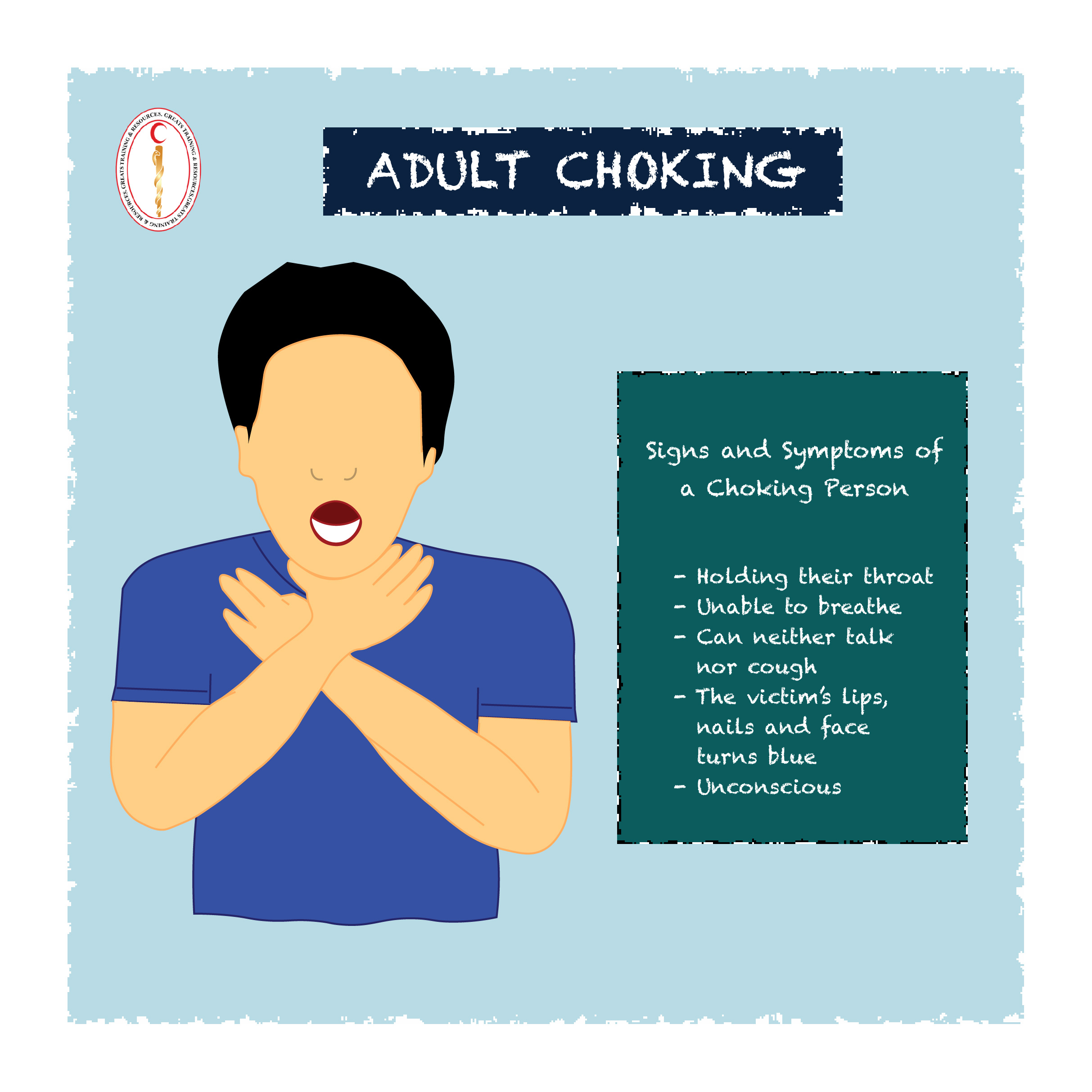
choking visual guide

If the victim is fully choking, you will be required to perform a Heimlich Maneuver (only for adults and children above 1-year-old). Stand behind the victim, make your hands into a fist and place it on the victim’s abdomen – one on top of the other- between the navel and xiphoid. Proceed to give a deep, upward thrust until the object is dislodged or till the victim becomes unconscious.

If the victim collapses, then proceed to lie them down, open their airway. Look for any signs of life, if none, then begin CPR.

*Do not perform Heimlich Maneuver on infants. 

**Disclaimer: This is merely for educational purposes, please get a professional to assist you in case of an emergency. 

It is vital that you are well equipped with this knowledge in case of an emergency. So take your first step by booking a First Aid & CPR class with us right away. Drop your details here, and we’ll get back to you right away with a personalized quote. If you’ve got any questions, feel free to give us a call at 019-3115146!

How Do You Handle an Emergency Case?

As a first aider, you are required to handle any/all emergency(s) in a calm and composed manner. Before providing aid, ensure that you possess a clear course of action; knowing exactly what to do based on the severity of the incident. And to ensure a smooth and safe procedure it is vital that you follow the steps below (as numbered).

1. Evaluate the scene and the surrounding area.

Once you have an accurate understanding and evaluation of the scene, proceed to introduce yourself calmly, and take charge of the case -only if there isn’t anyone more skilled or experienced than you.

2. Ensure your safety.

Before beginning any emergency aid, you are required to ensure that you are safe from any/all threats. Beware of any possible risks i.e. fire, sharp objects, explosive materials as well as any object that might cause you to stumble or fall.

3. Carry out a Primary Survey.

A Primary Survey for emergencies usually comprises of three things, Understanding the Incident, Evaluating the Current Situation, and Ensuring Safety. This survey is crucial in determining your first course of action, hence, make sure that you have carried out a thorough Primary Survey before proceeding.

**Disclaimer: This is merely for educational purposes, please get a professional to assist you in case of an emergency. 

For a more in-depth explanation on how you can and should handle an emergency case, contact us to schedule a class right away!